Dual Enrollment: Earn 30 College Credits Before 2026 Graduation
Dual enrollment provides high school students with a unique opportunity to gain a substantial head start on their higher education, potentially accumulating up to 30 college credits before their 2026 graduation, thereby saving both time and financial resources.
Are you a high school student in the US, or a parent of one, looking for a way to get ahead in your academic journey? Exploring the world of dual enrollment benefits could be one of the most strategic decisions you make, offering a pathway to earn up to 30 college credits before your high school graduation in 2026.
Understanding dual enrollment: a pathway to early college success
Dual enrollment programs have become increasingly popular, offering high school students a unique opportunity to take college-level courses and earn credits that count towards both their high school diploma and a future college degree. This innovative approach to education effectively bridges the gap between secondary and higher education, providing a smoother transition for motivated students.
The core concept revolves around allowing students to experience college academics while still in a familiar high school environment or at a local college campus. This early exposure can be incredibly beneficial, helping students gauge their readiness for college-level work and explore potential majors without the full financial and social pressures of a traditional freshman year.
How dual enrollment works
Typically, dual enrollment programs are partnerships between high schools and local colleges or universities. Students enroll in specific courses that are recognized by both institutions. These courses are often taught by college faculty, either on a college campus, at the high school, or even online, providing flexibility for students with varying schedules and locations.
- Students apply to a dual enrollment program, often requiring a minimum GPA.
- They select college courses approved by their high school counselor.
- Credits earned apply to both high school graduation requirements and college transcripts.
- Programs can vary significantly by state, district, and institution.
In essence, dual enrollment isn’t just about accumulating credits; it’s about gaining a head start on college, reducing future tuition costs, and developing essential academic skills earlier. This foundational experience can be instrumental in shaping a student’s educational trajectory and future career prospects.
Significant financial advantages: saving on future college costs
One of the most compelling reasons to consider dual enrollment is the substantial financial savings it offers. College tuition fees continue to rise, making any opportunity to reduce the overall cost of a degree highly attractive. Earning up to 30 college credits through dual enrollment can translate into thousands of dollars in savings.
Many dual enrollment programs offer courses at a significantly reduced rate compared to standard college tuition, or even for free, depending on state and district policies. This can alleviate a considerable financial burden on families, making higher education more accessible and affordable. Imagine entering college as a sophomore, having already completed a full year’s worth of general education requirements without paying full price.
Calculating your savings potential
The exact amount saved will vary based on the number of credits earned and the cost per credit hour at the student’s chosen future institution. However, even a conservative estimate reveals significant benefits. If a typical college credit costs $500, earning 30 credits through dual enrollment could save a family $15,000 in tuition alone. This doesn’t even account for associated fees or the potential to graduate earlier, thus saving on living expenses.
- Reduced or free tuition for dual enrollment courses.
- Less student loan debt upon graduation.
- Opportunity to graduate college early, saving on living and miscellaneous expenses.
- Access to college resources without the full cost.
These financial advantages extend beyond immediate savings; they also impact a student’s long-term financial health. Graduating with less debt means greater financial freedom post-college, allowing for earlier investment in careers, housing, or further education. The strategic financial planning inherent in dual enrollment makes it a smart choice for budget-conscious families.
Academic acceleration: graduating earlier and boosting college readiness
Beyond the financial benefits, dual enrollment provides a powerful boost to academic acceleration and college readiness. Earning college credits while still in high school means students can potentially shorten their time in college, allowing them to graduate earlier, pursue advanced degrees sooner, or enter the workforce with a competitive edge.
The experience of taking college-level courses also prepares students for the rigor and expectations of higher education. They learn to navigate college systems, manage heavier workloads, and develop critical thinking skills in a more structured and supported environment than if they were to jump directly into a full college schedule. This foundational experience can significantly reduce the culture shock often associated with the transition to college.
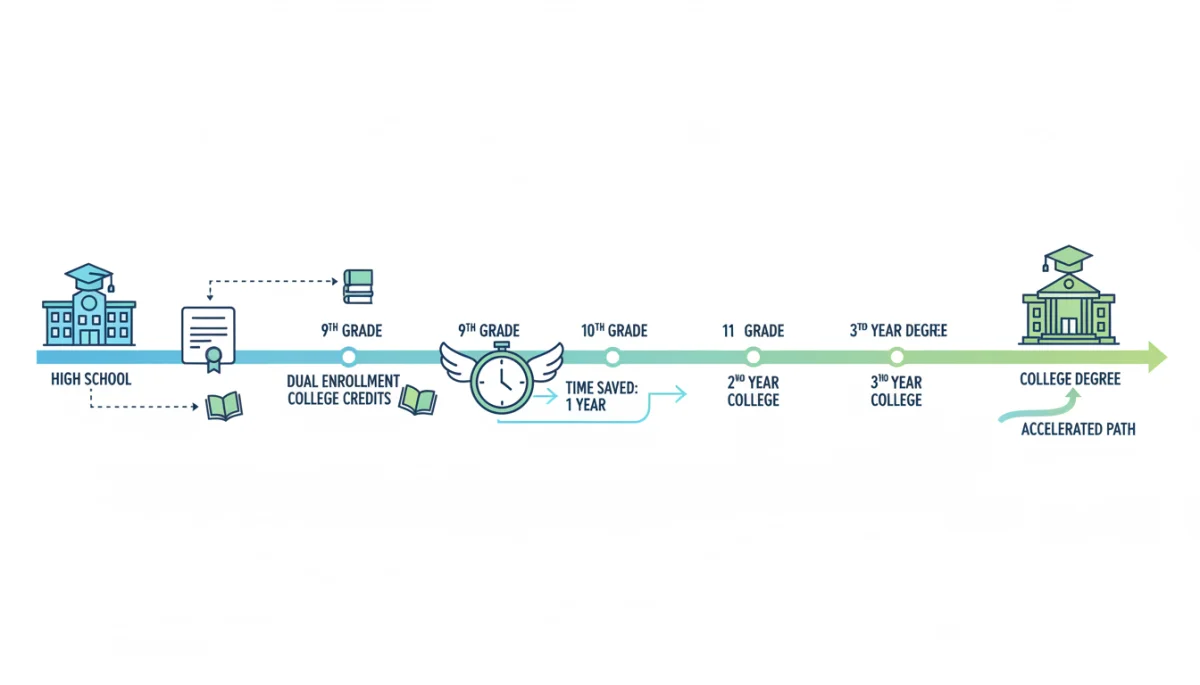
Students who participate in dual enrollment often report feeling more confident and prepared for college. They have a clearer understanding of academic expectations, a developed sense of self-advocacy, and familiarity with college-level research and writing. This readiness translates into higher success rates in their subsequent college careers.
Developing essential college skills
- Time management and organizational skills for heavier academic loads.
- Critical thinking and analytical abilities through college-level assignments.
- Improved research and writing skills, crucial for university success.
- Familiarity with college campus resources and academic support systems.
The academic head start provided by dual enrollment is not merely about accumulating credits; it’s about cultivating a mindset of continuous learning and developing the essential toolkit needed to thrive in a collegiate setting. This early exposure and skill development can be a game-changer for a student’s academic future.
Exploring interests and career paths through diverse coursework
Dual enrollment offers an invaluable opportunity for high school students to explore a wider range of academic interests and potential career paths than typically available within the high school curriculum. By taking college courses, students can delve into subjects they might not encounter until their sophomore or junior year of college, helping them make more informed decisions about their major and future career.
This exploratory phase is crucial for personal and academic development. It allows students to test the waters in various fields, from STEM subjects to humanities, arts, and social sciences, without the pressure of committing to a specific major. This can prevent costly changes in majors later in college and ensure a more focused and fulfilling educational journey.
For example, a student interested in engineering might take an introductory calculus or physics course at a local college, gaining firsthand experience with the subject matter and determining if it aligns with their expectations and capabilities. Similarly, an aspiring journalist could enroll in a college-level writing or communications class.
Benefits of diverse course selection
- Exposure to advanced topics beyond high school offerings.
- Opportunity to confirm or redirect career interests early on.
- Access to college faculty with specialized expertise.
- Building a more robust and diverse college application profile.
The ability to sample college courses across different disciplines gives students a significant advantage in shaping their academic and professional future. It fosters a deeper understanding of their passions and aptitudes, leading to more confident and well-informed decisions regarding their higher education and career trajectories.
Enhanced college application and admission prospects
Participating in dual enrollment programs can significantly strengthen a student’s college application, making them a more attractive candidate for competitive universities. Admissions committees often view dual enrollment participation as a strong indicator of a student’s academic ambition, readiness for college-level work, and intellectual curiosity.
When reviewing applications, colleges look for evidence that a student can handle rigorous academic challenges. Dual enrollment courses, especially those resulting in college credits, demonstrate this capability far more effectively than standard high school courses. It signals that the student is proactive, motivated, and serious about their education.
Furthermore, earning a strong GPA in college-level courses through dual enrollment provides tangible proof of academic excellence that can stand out in a crowded applicant pool. It shows admissions officers that the student has already successfully navigated the college academic environment, which can ease concerns about their transition to university life.
Key advantages for college admissions
- Demonstrates academic rigor and preparedness for college.
- Showcases intellectual curiosity and a proactive approach to learning.
- Offers a strong GPA in college-level coursework.
- May lead to preferential admission in some partner institutions.
In a highly competitive admissions landscape, having dual enrollment credits on a transcript can be a significant differentiator. It communicates to colleges that a student is not just prepared for higher education, but has already taken concrete steps toward achieving their academic goals, making them a desirable addition to any university.
Navigating challenges and maximizing dual enrollment success
While the dual enrollment benefits are numerous, it’s also important for students and families to be aware of potential challenges and strategies for maximizing success. The transition to college-level coursework can be demanding, requiring strong organizational skills, self-discipline, and effective time management.
One common challenge is balancing the increased academic workload of college courses with existing high school commitments, extracurricular activities, and social life. Students must be prepared to dedicate more time to studying and assignments than they might be accustomed to in high school. Communication with both high school counselors and college instructors is key to managing expectations and seeking support when needed.
Another consideration is the transferability of credits. While many dual enrollment credits are widely accepted, it’s crucial to verify with prospective colleges and universities that the credits earned will transfer and apply to the student’s chosen degree program. This proactive step can prevent disappointment and ensure the credits are truly beneficial.
Strategies for optimizing dual enrollment experience
- Prioritize time management and organization to balance workloads.
- Communicate regularly with high school counselors and college advisors.
- Verify credit transferability with target colleges early in the process.
- Utilize college resources like tutoring centers and academic support systems.
- Choose courses wisely, aligning with interests and future academic goals.
By proactively addressing these potential hurdles and leveraging available support systems, students can fully capitalize on the advantages of dual enrollment. The effort invested in navigating these challenges will undoubtedly pay off in terms of academic achievement, personal growth, and a smoother path to higher education.
| Key Benefit | Brief Description |
|---|---|
| Cost Savings | Potentially save thousands on college tuition by earning credits at a reduced cost or for free. |
| Academic Head Start | Graduate college earlier or pursue advanced degrees by entering with up to 30 credits. |
| College Readiness | Develop essential college-level skills and adapt to higher education demands early. |
| Enhanced Applications | Strengthen college applications by demonstrating academic rigor and motivation. |
Frequently asked questions about dual enrollment
Dual enrollment allows high school students to take college-level courses, earning credits that count towards both their high school diploma and a future college degree. These programs are typically offered through partnerships between high schools and local colleges or universities, providing an early start on higher education.
Students can often earn a significant number of college credits, frequently up to 30 or more, before high school graduation. The exact number depends on the specific program, state regulations, and the student’s academic plan and capacity to manage the coursework effectively.
While many dual enrollment credits are widely accepted, transferability is not always guaranteed. It’s crucial for students to confirm with their prospective colleges and universities that the specific credits they earn will be accepted and applied to their chosen degree program before enrolling in courses.
The cost of dual enrollment courses varies. Some states and districts offer them for free, while others may charge a reduced tuition rate per credit. It’s important to check with your high school counselor or the partnering college for specific cost information and any available financial aid options.
Dual enrollment helps students develop college-level academic skills, including critical thinking, time management, and advanced research. It exposes them to the rigor of higher education and college campus environments, making the transition to full-time university studies much smoother and less daunting.
Conclusion
The opportunity to leverage dual enrollment benefits and earn up to 30 college credits before high school graduation in 2026 presents a transformative pathway for ambitious students across the US. From significant financial savings and academic acceleration to enhanced college readiness and broader exploration of career interests, the advantages are clear and compelling. While careful planning and commitment are required to navigate the challenges, the long-term rewards of a head start in higher education are undeniable, setting students on a trajectory for greater academic and professional success.
