Maximize Your GI Bill Benefits 2026: A Veteran’s Education Guide

Maximizing your GI Bill benefits in 2026 requires understanding eligibility, applying strategically, and selecting programs that align with your educational and career goals to ensure optimal utilization of this invaluable veteran resource.
For many US veterans, the GI Bill represents a powerful pathway to higher education and career advancement. Navigating the complexities of these benefits can seem daunting, but with the right information and a strategic approach, you can truly unlock its full potential. This guide is designed to help you with Maximizing Your GI Bill Benefits in 2026: A Step-by-Step Guide for US Veterans’ Education, ensuring you make informed decisions for your academic and professional future.
understanding your GI Bill options in 2026
Before diving into the application process, it’s crucial to understand the different types of GI Bill benefits available and what each offers. The landscape of veteran education benefits can evolve, even subtly, so staying informed about the specifics for 2026 is your first step toward successful utilization. Each program has unique eligibility criteria and varying levels of financial support, making it essential to identify which one best suits your service history and educational aspirations.
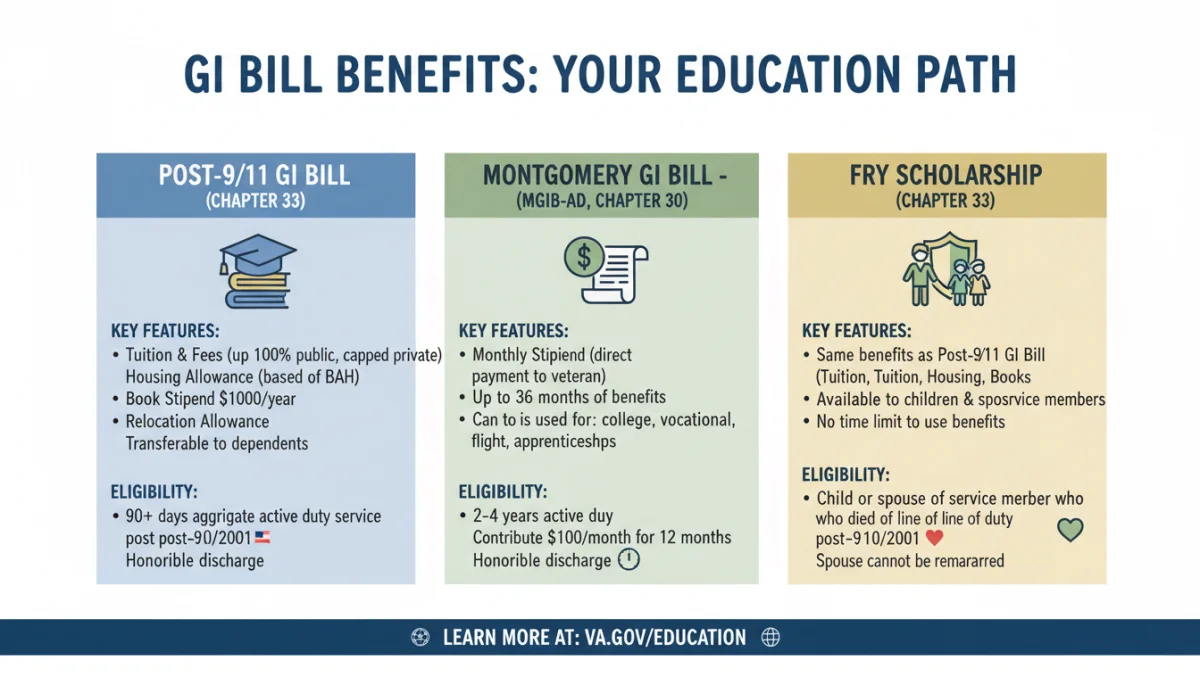
The primary benefit used by most post-9/11 veterans is the Post-9/11 GI Bill, but other options like the Montgomery GI Bill (MGIB-AD and MGIB-SR) and the Fry Scholarship remain highly relevant for specific service members and their dependents. Knowing the distinctions between these programs will directly impact the type and amount of benefits you receive, from tuition coverage to housing allowances and book stipends.
Post-9/11 GI Bill (Chapter 33)
The Post-9/11 GI Bill is often considered the most comprehensive benefit for veterans who served on active duty after September 10, 2001. It provides financial support for education and housing to individuals with at least 90 days of aggregate service after 9/10/01, or individuals discharged with a service-connected disability after 30 days. The level of benefits you receive is directly tied to your length of service.
- Full tuition and fees for in-state public schools
- Monthly housing allowance (MHA) based on the E-5 basic allowance for housing (BAH) with dependents rate at the school’s zip code
- Annual book and supplies stipend up to $1,000
- Yellow Ribbon Program participation for private or out-of-state tuition gaps
Montgomery GI Bill (MGIB-AD and MGIB-SR)
While less common for recent veterans, the Montgomery GI Bill remains an option for those who opted into it during their service. The Active Duty (MGIB-AD) version is for those who served at least two years on active duty. The Selected Reserve (MGIB-SR) is for members of the Selected Reserve who incur a six-year obligation.
- Provides a set monthly payment directly to the veteran
- No direct tuition payment to the school
- No housing allowance or book stipend
- Benefits are paid for up to 36 months
Understanding these fundamental differences is critical. For instance, the Post-9/11 GI Bill pays tuition directly to the institution and provides a housing allowance, which can be a significant advantage. In contrast, the Montgomery GI Bill provides a monthly stipend directly to the veteran, who is then responsible for all educational costs. Carefully evaluate your eligibility for each to determine the most advantageous path for your educational journey in 2026.
confirming your eligibility and gathering documentation
Once you have a general understanding of the available GI Bill programs, the next crucial step is to confirm your specific eligibility and begin gathering all necessary documentation. This phase is foundational to a smooth application process and helps prevent delays. Eligibility criteria vary slightly between the different GI Bill chapters, so a precise review of your service record is paramount.
The Department of Veterans Affairs (VA) is the primary resource for confirming eligibility. Their website and dedicated helplines offer comprehensive information and support. It’s often helpful to have your service records readily available, as these documents will be essential for verifying your service dates, discharge status, and any other relevant military information that impacts your benefits.
Key eligibility factors for the Post-9/11 GI Bill
For the Post-9/11 GI Bill, your length of active duty service after September 10, 2001, is the main determinant of your benefit level. Generally, 90 days of aggregate service will qualify you for 40% of the maximum benefit, with benefits increasing incrementally up to 100% for 36 months of service or more. Specific discharge conditions also play a role.
- Honorable discharge or released for a service-connected disability
- At least 90 days of aggregate active duty service after September 10, 2001
- Or, 30 days of continuous service and discharged due to a service-connected disability
Necessary documentation for your application
Collecting your documents early can save considerable time and stress. The VA will require proof of service and other personal information to process your application. Having these ready will streamline the entire procedure.
- DD Form 214, Certificate of Release or Discharge from Active Duty
- Social Security number
- Bank account direct deposit information (account and routing number)
- Information about the school or training program you plan to attend
It’s advisable to review your DD Form 214 carefully to ensure all information is accurate. Any discrepancies could lead to delays in your application. If you need to request a copy of your DD Form 214 or other service records, the National Archives website is the official resource. Proactively gathering these items will significantly expedite your GI Bill application for 2026, allowing you to focus more on your academic pursuits.
the application process: step-by-step for 2026
Applying for your GI Bill benefits might seem complex, but by breaking it down into manageable steps, the process becomes much clearer. The VA has worked to simplify the application, primarily through their online portal. For 2026, the general procedures remain consistent with previous years, emphasizing digital submission for efficiency and accuracy.
The first and most critical step is to complete the VA Form 22-1990, Application for VA Education Benefits. This form initiates your request for benefits and allows the VA to determine your eligibility and the specific chapter of the GI Bill you qualify for. Ensure all information is accurate and complete to avoid processing delays.
Online application through va.gov
The most efficient way to apply is through the VA’s official website, va.gov. This platform guides you through the application questions and allows for electronic submission of required documents. Creating an account on va.gov is recommended, as it allows you to track the status of your application and manage your benefits.
- Visit va.gov and navigate to the education benefits section.
- Select “Apply for education benefits” and choose VA Form 22-1990.
- Fill out all sections accurately, providing personal details, service history, and educational goals.
- Upload supporting documents, such as your DD Form 214, if prompted.
What happens after you apply?
Once your application is submitted, the VA will review it to determine your eligibility. This process typically takes a few weeks, though it can vary based on volume. You will receive a Certificate of Eligibility (COE) in the mail, which outlines your specific benefits, the percentage of eligibility, and the remaining entitlement.
- Receive your Certificate of Eligibility (COE) from the VA.
- Present your COE to the School Certifying Official (SCO) at your chosen educational institution.
- The SCO will certify your enrollment with the VA, triggering your benefit payments.
It’s important to communicate regularly with both the VA and your school’s SCO. They are your primary points of contact for any questions or issues that may arise during the application and certification process. Proactive engagement ensures that your educational funding is processed correctly and on time, setting you up for academic success.
choosing the right educational program and institution
Selecting the appropriate educational program and institution is a cornerstone of maximizing your GI Bill benefits. Your choice should align with your career aspirations, academic strengths, and the practical application of your benefits. Not all programs or schools are created equal in terms of how they integrate with VA education benefits, so thorough research is crucial for 2026.
Consider the accreditation of the institution and the specific program you are interested in. Accreditation ensures that the education you receive meets recognized standards, which is vital for transferability of credits and employer recognition. Also, look for schools with strong veteran support services, as these can significantly enhance your academic experience.
Accreditation and program approval
The VA only pays for programs offered by accredited institutions and approved by the state approving agency. Before enrolling, verify that both the school and your desired program are approved for GI Bill benefits. You can use the VA’s GI Bill Comparison Tool to research schools and programs that accept VA education benefits.
- Verify institutional accreditation through recognized accrediting bodies.
- Confirm program-specific approval for GI Bill funding.
- Utilize the VA’s GI Bill Comparison Tool for school research.
Veteran-friendly schools and support services
Many institutions are actively working to support student veterans. These schools often have dedicated veteran centers, academic advisors specializing in veteran affairs, and participate in programs like the Yellow Ribbon Program. Such resources can make a significant difference in your transition from military to academic life.
- Look for schools with a dedicated veteran affairs office or center.
- Inquire about academic support, mental health services, and career counseling tailored for veterans.
- Prioritize institutions participating in the Yellow Ribbon Program if you plan to attend a private or out-of-state public school.
Making an informed decision about your educational path is not just about choosing a major; it’s about choosing an environment that will foster your success. Researching schools and programs that actively support veterans and are fully compliant with GI Bill regulations will ensure you get the most out of your earned benefits in 2026, setting a strong foundation for your future career.
strategic utilization of your benefits: tips for 2026
Beyond simply applying for the GI Bill, strategically utilizing your benefits can amplify their impact on your educational and career journey. This involves careful planning, understanding financial nuances, and leveraging additional resources available to veterans. For 2026, a proactive approach will ensure you maximize every aspect of your entitlement.
One key strategy is to plan your course load effectively. The Post-9/11 GI Bill’s Monthly Housing Allowance (MHA) is paid based on your enrollment status and the rate of pursuit. Being enrolled as a full-time student generally provides the highest MHA, which can be crucial for covering living expenses during your studies. Under-enrolling can reduce your MHA, so understand the implications.
Understanding your monthly housing allowance (MHA)
The MHA is a significant component of the Post-9/11 GI Bill. It’s paid directly to you at the beginning of each month for the previous month’s enrollment. The rate is determined by the E-5 Basic Allowance for Housing (BAH) with dependents for the zip code of your school, adjusted for your rate of pursuit. For example, if you are a full-time student, you will receive 100% of the MHA, whereas a half-time student will receive 50%.
- Maintain full-time enrollment to receive the maximum MHA.
- Be aware of how breaks in enrollment can affect your MHA payments.
- Consider the cost of living in your chosen school’s area when planning your budget.
Leveraging the Yellow Ribbon Program
If you’re considering attending a private school or an out-of-state public university where tuition exceeds the Post-9/11 GI Bill’s maximum tuition benefit, the Yellow Ribbon Program is invaluable. This program allows institutions to voluntarily enter into an agreement with the VA to fund tuition and fee expenses that exceed the maximum GI Bill cap.
- Check if your desired school participates in the Yellow Ribbon Program.
- Understand that the school determines the number of students and the amount contributed.
- Apply early, as Yellow Ribbon funds are often awarded on a first-come, first-served basis.
Furthermore, don’t overlook other VA educational benefits, such as tutorial assistance or licensing and certification test reimbursement. These can cover additional costs that further support your academic and professional development. By thoughtfully planning your academic journey and understanding the intricate details of your GI Bill benefits, you can ensure a successful and financially sound educational experience in 2026.
monitoring your benefits and maintaining eligibility
Once you’ve begun using your GI Bill benefits, it’s essential to actively monitor your remaining entitlement and ensure you maintain eligibility. This proactive approach prevents unexpected interruptions in funding and allows you to plan effectively for the completion of your degree or program. The VA provides several tools and resources to help you stay informed about your benefit status for 2026.
Regularly checking your remaining entitlement is crucial. The Post-9/11 GI Bill typically provides up to 36 months of benefits. Knowing how many months you have left will inform decisions about changing majors, taking breaks, or pursuing advanced degrees. The VA’s eBenefits portal is your go-to resource for this information.
Checking your remaining entitlement
The eBenefits portal is a secure online platform where veterans can access their benefits information, including their remaining GI Bill entitlement. Creating an account and regularly logging in will provide you with up-to-date details on your benefits usage and remaining balance.
- Create or log in to your eBenefits account on va.gov.
- Navigate to the education section to view your remaining entitlement.
- Keep track of your monthly usage against the total 36 months of benefits.
Maintaining satisfactory academic progress
To continue receiving GI Bill benefits, you must maintain satisfactory academic progress (SAP) as defined by your educational institution. Failing to meet SAP can result in the termination of your benefits. Each school has its own SAP policy, usually involving a minimum GPA and completion rate for attempted credits.
- Understand your school’s satisfactory academic progress (SAP) policy.
- Monitor your GPA and credit completion rate regularly.
- Seek academic support or counseling if you are struggling with your coursework.
It’s also important to notify the VA and your school’s School Certifying Official (SCO) of any changes in your enrollment status, such as dropping a course, withdrawing from school, or changing your major. These changes can impact your benefits and housing allowance, and timely reporting can prevent overpayments or underpayments. Staying vigilant about your academic standing and benefit status ensures a continuous and smooth educational journey through 2026 and beyond.
additional resources and support for veteran students
Beyond the core GI Bill benefits, a wealth of additional resources and support systems exist to help veteran students succeed in their academic and professional endeavors. Leveraging these can significantly enhance your experience, provide financial relief, and foster a strong sense of community. For 2026, exploring these supplementary options is a vital part of maximizing your overall support structure.
Many organizations, both governmental and non-profit, are dedicated to assisting veterans in higher education. These resources can range from scholarships specifically for veterans to mentorship programs and career development services. Integrating these into your educational plan can provide a holistic support network.
Scholarships and financial aid for veterans
While the GI Bill covers substantial costs, additional scholarships can help with expenses not covered, such as living costs, transportation, or specialized equipment. Many foundations and organizations offer scholarships exclusively for veterans, often with specific criteria related to service, academic major, or personal circumstances.
- Research veteran-specific scholarships from organizations like the Pat Tillman Foundation, Army Emergency Relief, or Marine Corps Scholarship Foundation.
- Complete the Free Application for Federal Student Aid (FAFSA) to determine eligibility for federal grants and loans.
- Explore school-specific scholarships and grants that may be available to veteran students.
Veteran support organizations and mentorship
Connecting with other veterans and support organizations can provide invaluable peer support, networking opportunities, and guidance. Organizations like Student Veterans of America (SVA) have chapters on many college campuses, offering a community and advocacy for veteran students. Mentorship programs can also connect you with experienced veterans who can offer advice on career transitions and academic success.
- Join your school’s Student Veterans of America (SVA) chapter or other veteran student groups.
- Look for mentorship programs that pair student veterans with professional mentors.
- Utilize career services departments at your institution, many of which have advisors specializing in veteran employment.
Remember that your transition to civilian and academic life is a journey, and you don’t have to navigate it alone. Actively seeking out and utilizing these additional resources can provide the extra support needed to thrive, ensuring that you not only succeed academically but also build a strong foundation for your post-education career in 2026.
| Key Aspect | Brief Description |
|---|---|
| Understand Benefits | Differentiate between Post-9/11, Montgomery, and Fry Scholarship benefits to choose the best fit. |
| Confirm Eligibility | Verify service requirements and gather all necessary documentation like DD Form 214. |
| Strategic Program Choice | Select accredited schools and programs with strong veteran support, leveraging the Yellow Ribbon Program. |
| Monitor & Maintain | Regularly check remaining entitlement and maintain satisfactory academic progress to ensure continuous benefits. |
frequently asked questions about GI Bill benefits in 2026
The Post-9/11 GI Bill (Chapter 33) provides extensive education benefits for veterans who served at least 90 days on active duty after September 10, 2001, or were discharged with a service-connected disability after 30 days. Benefits cover tuition, housing, and books, based on length of service.
You can apply online through the VA’s official website, va.gov, by completing VA Form 22-1990. Ensure you have your DD Form 214 and other personal information ready. After submission, the VA will review your application and send a Certificate of Eligibility.
The Yellow Ribbon Program helps cover tuition costs at private or out-of-state public schools that exceed the Post-9/11 GI Bill’s maximum tuition cap. If your chosen institution participates and you have 100% Post-9/11 GI Bill eligibility, it can significantly reduce out-of-pocket expenses.
You can check your remaining GI Bill entitlement by logging into your eBenefits account on va.gov. This portal provides an up-to-date overview of your benefits usage, including the number of months remaining and your current eligibility status.
Yes, many organizations offer scholarships specifically for veterans, such as the Pat Tillman Foundation. Additionally, completing the FAFSA can determine your eligibility for federal grants and loans. Always explore school-specific opportunities and veteran support programs for comprehensive financial assistance.
conclusion
The GI Bill remains an indispensable asset for US veterans pursuing higher education and career advancement. By understanding your options, diligently navigating the application process, and strategically utilizing your benefits, you can unlock a world of educational opportunities in 2026. Remember to stay informed about your eligibility, maintain satisfactory academic progress, and leverage the myriad of additional resources available. Your service has earned you these benefits; now, empower yourself to make the most of them for a successful future.
