2026 Guide to Service Contracts: Avoid Surprises Before Signing

Understanding service contracts in 2026 is vital for consumers and businesses alike, requiring careful review of terms, conditions, and potential liabilities to prevent future disputes and financial losses.
In today’s fast-paced world, engaging in various services has become commonplace, whether it’s subscribing to a new streaming platform, hiring a contractor for home improvements, or signing up for a cutting-edge software solution. Each of these interactions often involves a legal document known as a service contract. This service contract guide 2026 aims to equip you with the knowledge needed to navigate these agreements confidently, ensuring you understand every detail before committing to anything that could lead to unexpected complications down the line. Taking the time to comprehend these documents is not just a recommendation; it’s a necessity in safeguarding your interests.
The foundational elements of a service contract
At its core, a service contract is a legally binding agreement between two or more parties where one party agrees to provide a specific service to another in exchange for compensation. These contracts are designed to protect both the service provider and the client, outlining expectations, responsibilities, and remedies should issues arise. Understanding the fundamental components is the first step toward a secure agreement.
A well-drafted service contract leaves little room for ambiguity. It clearly defines the nature of the service, the duration of the agreement, and the financial obligations of each party. Without these clear stipulations, misunderstandings can quickly escalate into costly disputes.
Defining the scope of work and deliverables
The most critical section of any service contract is the detailed description of the services to be provided. This section, often called the ‘Scope of Work’ (SOW), specifies exactly what the service provider will do and, equally important, what they will not do. Ambiguity here is a primary cause of conflict.
- Specific tasks: Clearly list all tasks the service provider is responsible for.
- Deliverables: Define any tangible or intangible outputs expected, such as reports, software, or completed projects.
- Exclusions: Explicitly state any services or tasks that are not included in the agreement to manage expectations.
- Quality standards: If applicable, outline the quality benchmarks or performance metrics the service must meet.
Payment terms and conditions
Financial clarity is paramount. This part of the contract details how much you will pay, when you will pay it, and the accepted methods of payment. It also covers what happens if payments are delayed or missed.
Look for clauses related to upfront deposits, milestone payments, and final payment schedules. Ensure there are no hidden fees or charges not explicitly mentioned in this section. Transparency in payment terms builds trust and prevents future financial disagreements.
In conclusion, a robust understanding of a service contract’s foundational elements—namely the scope of work and comprehensive payment terms—is indispensable. These sections set the stage for the entire relationship, dictating what is expected and how it will be compensated, thereby minimizing the potential for future disputes and ensuring a smooth service delivery process.
Navigating termination clauses and dispute resolution
Even the best-planned service relationships can encounter unforeseen difficulties, making termination clauses and dispute resolution mechanisms vital components of any service contract. These sections dictate how the agreement can be ended and what steps should be taken if disagreements arise. Ignoring these provisions can leave you vulnerable to prolonged legal battles or significant financial penalties.
A solid understanding of these clauses ensures that you have a clear path forward, regardless of whether the service relationship concludes amicably or due to irreconcilable differences. It’s about protecting your exit strategy and ensuring fairness.
Understanding termination rights and penalties
Termination clauses specify the conditions under which either party can end the contract before its natural expiration. This can include termination for convenience (without cause) or termination for cause (due to a breach of contract).
- Notice period: How much advance notice is required for termination?
- Early termination fees: Are there penalties for ending the contract prematurely?
- Refund policies: What happens to payments made or services rendered if the contract is terminated?
- Return of property: Provisions for returning company assets or confidential information.
Mechanisms for resolving disputes
Dispute resolution outlines the procedures parties must follow to resolve conflicts without resorting to court. Common methods include negotiation, mediation, and arbitration.
Mediation involves a neutral third party facilitating discussions, while arbitration involves a neutral third party making a binding decision. It’s important to understand which method is stipulated and its implications for cost and finality. Sometimes, contracts will specify that disputes must be resolved in a particular jurisdiction, which can be a significant factor if the parties are in different states or countries.
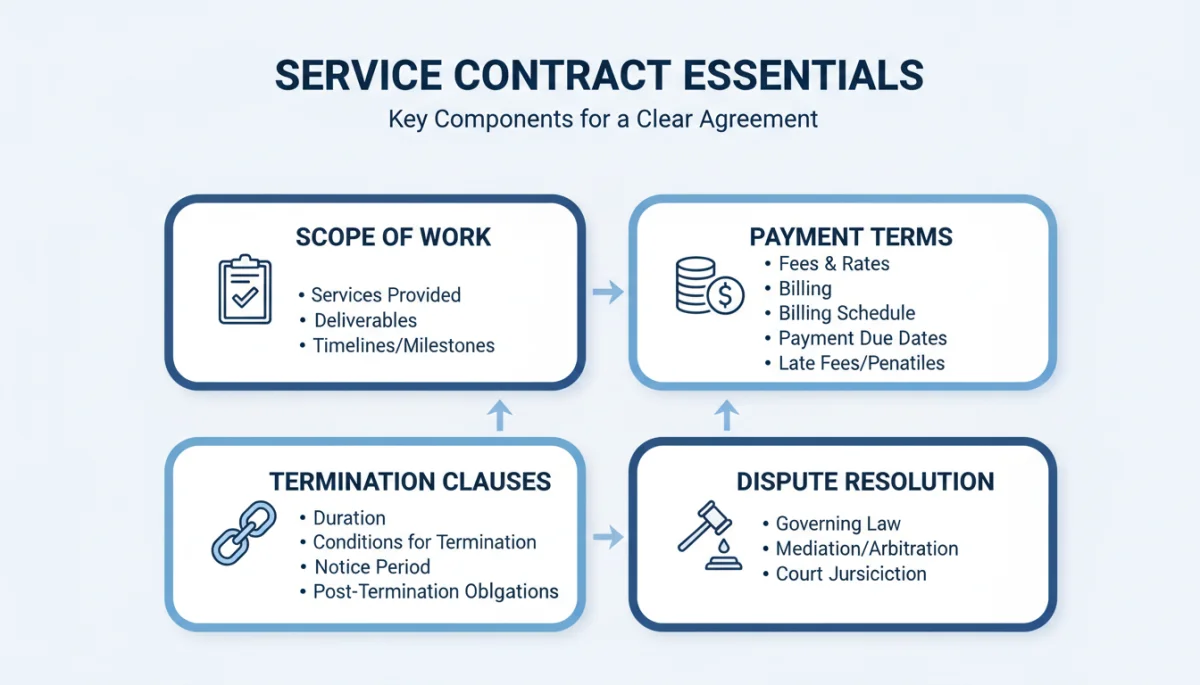
In sum, paying close attention to termination clauses and dispute resolution procedures within a service contract is crucial. These sections provide a roadmap for managing the end of a service relationship and addressing conflicts effectively, ensuring that both parties are aware of their rights and obligations should the agreement not proceed as initially planned.
The fine print: liabilities, indemnities, and warranties
Beyond the core services and payment terms, the fine print of a service contract often holds critical clauses related to liabilities, indemnities, and warranties. These sections are designed to allocate risk and responsibility between the parties, and overlooking them can expose you to significant financial and legal repercussions. A thorough review of these details is non-negotiable for anyone looking to sign a service agreement.
These clauses are not just legal jargon; they are fundamental protections that define who pays for damages, who takes responsibility for losses, and what guarantees are provided for the service rendered. Understanding them ensures you know your maximum exposure and what recourse you have if things go wrong.
Limitation of liability clauses
Limitation of liability clauses cap the amount of damages one party can claim from the other if a breach of contract or negligence occurs. These caps can be a fixed monetary amount or tied to the total value of the contract.
It’s essential to assess if the liability cap is reasonable given the potential risks involved with the service. If the cap is too low, you might not be adequately compensated for significant losses. Conversely, if you are the service provider, an unreasonably high cap could expose you to excessive risk. Always consider what could realistically go wrong and if the liability limits provide fair protection for both sides.
Indemnification provisions
Indemnification clauses require one party to compensate the other for certain losses or damages. For example, a service provider might agree to indemnify the client against claims arising from the provider’s negligence or intellectual property infringement.
- Scope of indemnity: What specific events or actions trigger indemnification?
- Exclusions: Are there any circumstances where indemnification does not apply?
- Procedures: What steps must be followed to claim indemnification?
Service warranties and guarantees
Warranties and guarantees specify the quality or performance standards the service provider promises to meet. These clauses offer assurance that the service will be delivered as expected and provide remedies if it falls short.
Look for details on the duration of the warranty, what defects or failures it covers, and the process for making a claim. A strong warranty can be a significant indicator of a service provider’s confidence in their offerings. Conversely, the absence of clear warranties might be a red flag, suggesting a lack of commitment to quality.
In conclusion, a meticulous examination of liability limitations, indemnification agreements, and service warranties is paramount when reviewing any service contract. These clauses are critical in defining risk allocation and offering recourse, ensuring that both parties are clearly aware of their responsibilities and protections against unforeseen circumstances and potential failures.
Confidentiality and intellectual property rights
In an increasingly digital and information-driven world, confidentiality and intellectual property (IP) rights are critical considerations within service contracts. Many services involve sharing sensitive information or creating new works, making these clauses essential for protecting proprietary data and ensuring proper ownership of new creations. Understanding these sections is vital for businesses and individuals alike.
Neglecting the details of confidentiality and IP can lead to severe consequences, from data breaches and loss of competitive advantage to disputes over ownership of valuable assets. These clauses aren’t just legal formalities; they are the bedrock of trust and innovation in a service relationship.
Protecting sensitive information
Confidentiality clauses, often referred to as Non-Disclosure Agreements (NDAs) within the contract, obligate parties to protect sensitive information shared during the service engagement. This includes trade secrets, customer data, and business strategies.
- Definition of confidential information: What specific types of information are covered?
- Obligations: How must the information be protected, and who can access it?
- Duration: How long does the confidentiality obligation last, even after the contract ends?
- Exclusions: Are there any types of information that are not considered confidential?
Ownership of intellectual property
Intellectual property clauses determine who owns the rights to any new creations, inventions, or works developed during the course of the service. This is particularly important for creative services like software development, graphic design, or content creation.
Often, contracts will state that any IP created by the service provider in the course of the project becomes the property of the client, known as “work for hire.” However, some agreements may stipulate that the provider retains ownership, granting the client a license to use the IP. It is crucial to clarify this upfront to avoid future disputes over ownership and usage rights, ensuring that your investment translates into tangible assets you control.
In summary, comprehensive attention to confidentiality and intellectual property rights within service contracts is fundamental. These provisions safeguard sensitive data and clarify ownership of creative outputs, establishing a clear framework that fosters trust and prevents significant legal and proprietary conflicts down the line.
Renewals, amendments, and governing law
The longevity and adaptability of a service contract often hinge on its clauses regarding renewals, amendments, and the governing law. These sections dictate how the agreement can be extended, modified, and under which legal framework it operates. A clear understanding here ensures the contract remains relevant, enforceable, and aligned with current needs over time. Without these provisions, a contract can quickly become outdated or legally ambiguous.
These administrative details, while seemingly minor, can have profound impacts on the long-term viability and legal standing of your service agreement. Knowing how to change, extend, or legally challenge aspects of the contract is just as important as understanding the initial service terms.
Automatic renewals and contract extensions
Many service contracts include provisions for automatic renewal, meaning the agreement will continue for another term unless one party explicitly cancels it. While convenient, this can also lead to unintended commitments if not monitored carefully.
- Notice period for non-renewal: How far in advance must you notify the other party if you don’t want to renew?
- Terms of renewal: Do the terms and pricing remain the same, or do they change upon renewal?
- Opt-out options: Is there a clear and easy process to prevent automatic renewal?
Amending and modifying the agreement
Circumstances change, and contracts often need to be updated. Amendment clauses outline the process for making modifications to the original agreement. Typically, amendments require written consent from all parties involved to be legally binding.
Ensure that the contract specifies that any changes must be in writing and signed by authorized representatives. Verbal agreements to modify a contract are generally not enforceable and can lead to confusion and disputes. A clear amendment process protects both parties from unilateral changes and ensures that all modifications are properly documented.
Governing law and jurisdiction
The governing law clause specifies which state or country’s laws will apply to the contract in case of a dispute. The jurisdiction clause indicates where any legal proceedings would take place. For contracts between parties in different locations, this is a crucial detail.
For example, a contract between a company in California and a client in New York might specify that California law governs the agreement and that any disputes will be heard in a California court. This can significantly impact the legal costs and convenience of resolving a dispute, so it’s important to be aware of the implications of the chosen jurisdiction.
In conclusion, carefully reviewing clauses related to renewals, amendments, and governing law is crucial for the long-term success and enforceability of any service contract. These provisions ensure the agreement remains current, adaptable, and legally sound, providing a clear framework for future adjustments and dispute resolution should the need arise.
Red flags and warning signs to watch out for
While a well-structured service contract aims to foster a clear and equitable relationship, certain provisions or omissions can signal potential problems. Recognizing these red flags before signing can save you from significant headaches, financial losses, or legal battles down the road. Vigilance during the review process is your best defense against unfavorable terms.
These warning signs aren’t always glaring; sometimes they are subtle omissions or overly broad statements that can have detrimental long-term effects. Developing an eye for these potential pitfalls is an invaluable skill for any consumer or business owner entering into a service agreement.
Vague language and unclear terms
A contract filled with ambiguous phrasing, undefined terms, or overly broad statements is a significant red flag. Clarity is paramount in legal documents, and vague language often leaves room for misinterpretation or exploitation.
- “Reasonable efforts”: What constitutes reasonable? This can be subjective.
- “Industry standards”: Without specific metrics, this can be hard to enforce.
- Incomplete scope of work: If the services aren’t precisely defined, you might not get what you expect.
Unilateral modification clauses
Be wary of clauses that allow one party to change the terms of the contract without the other party’s explicit consent. While some flexibility might be necessary, blanket unilateral modification clauses can put you at a severe disadvantage.
A fair contract requires mutual agreement for any significant changes. If a contract allows the service provider to alter pricing, scope, or other critical terms at their sole discretion, it could lead to unexpected costs or reduced service quality without your approval. Always seek a clause that requires written agreement from both parties for any amendments.
Excessive termination penalties or lack of exit options
While some termination fees are reasonable, excessively high penalties for early termination or a complete lack of clear exit strategies should raise concerns. A balanced contract should offer reasonable ways for both parties to disengage if the relationship isn’t working.
If a contract makes it extremely difficult or prohibitively expensive to terminate, you might be locking yourself into an unfavorable situation. Look for reasonable notice periods and transparent penalty structures. A contract that feels like a trap is usually one you should avoid. Furthermore, ensure that the contract clearly outlines the process for returning any shared assets or data upon termination, preventing future disputes over property.
In conclusion, maintaining a keen eye for red flags such as vague language, unilateral modification clauses, and excessive termination penalties is essential when reviewing service contracts. Recognizing these warning signs empowers you to negotiate better terms or walk away from potentially problematic agreements, ultimately protecting your interests and ensuring a fair partnership.
The importance of legal review and negotiation
While understanding the various components of a service contract is crucial, the complexity of legal language and the potential for significant financial implications underscore the importance of professional legal review. Engaging an attorney before signing can provide invaluable insights and protect you from unforeseen risks. Furthermore, knowing how to negotiate terms effectively can lead to a more favorable agreement.
Many individuals and businesses hesitate to involve legal counsel due to perceived costs, but the expense of a proactive legal review is often a fraction of what could be incurred from disputes or breaches resulting from an inadequately vetted contract. It’s an investment in peace of mind and long-term security.
When to seek legal counsel
It’s advisable to seek legal counsel for any service contract that involves substantial financial commitment, complex services, or significant intellectual property. This is especially true for contracts that are not standard, off-the-shelf agreements.
- High-value contracts: Agreements involving large sums of money or long-term commitments.
- Unique services: Contracts for bespoke software, custom development, or specialized consulting.
- International agreements: When parties are in different countries, leading to complexities in governing law.
- Unclear terms: If you don’t fully understand certain clauses or suspect ambiguity.
Strategies for effective negotiation
Negotiation isn’t about winning at all costs; it’s about reaching a mutually beneficial agreement. Approaching negotiations with a clear understanding of your priorities and a willingness to compromise can lead to stronger, more sustainable partnerships.
Before entering negotiations, identify your non-negotiables, your ideal outcomes, and areas where you are willing to concede. Be prepared to articulate your concerns clearly and provide alternative wording for clauses you find problematic. Remember that a contract should serve both parties, and a good negotiation leaves both sides feeling satisfied with the terms. Don’t be afraid to ask for clarifications or propose changes; most reputable service providers are open to reasonable adjustments to ensure client satisfaction and a smooth working relationship.
In conclusion, the decision to engage in a legal review and actively participate in contract negotiation is a strategic one that can significantly mitigate risks and enhance the overall value of a service agreement. These steps ensure that all terms are understood, fair, and aligned with your best interests, fostering a secure and productive service relationship.
| Key Point | Brief Description |
|---|---|
| Scope of Work | Clearly defines services, deliverables, and exclusions to prevent misunderstandings. |
| Payment Terms | Details costs, payment schedule, and methods, ensuring financial transparency. |
| Termination & Disputes | Outlines how to end the contract and resolve conflicts, protecting exit strategies. |
| Legal Review | Essential for complex contracts to identify risks and ensure fair terms before signing. |
Frequently asked questions (FAQ)
The primary purpose of a service contract is to establish a legally binding agreement between parties, clearly defining the services to be provided, terms of payment, and responsibilities. It protects both the service provider and the client by setting clear expectations and providing a framework for dispute resolution, minimizing misunderstandings and ensuring smooth project execution.
Termination clauses are crucial because they dictate how a contract can be ended prematurely, either for convenience or cause. They outline notice periods, potential penalties, and refund policies, providing an essential exit strategy. Understanding these clauses prevents unexpected financial burdens or protracted legal battles if the service relationship needs to conclude earlier than planned.
In intellectual property (IP) clauses, you should look for clear statements on who owns any creations or innovations developed during the service. Ensure it specifies whether it’s ‘work for hire’ (client owns IP) or if the provider retains ownership with a license granted to you. Clarity here prevents future disputes over ownership, usage rights, and potential commercialization of the IP.
It is necessary to seek legal counsel for service contracts involving significant financial commitments, complex services, or substantial intellectual property. Additionally, if the contract contains ambiguous language, unilateral modification clauses, or excessive termination penalties, legal review is strongly recommended. Proactive legal advice can prevent costly disputes and ensure fair terms.
To avoid unwanted automatic contract renewals, carefully read the renewal clause for specific notice periods required for non-renewal. Mark these dates on your calendar and provide written notification well in advance if you wish to terminate the agreement. Confirm that the contract specifies clear opt-out options and that you understand any changes in terms or pricing upon renewal.
Conclusion
Navigating service contracts in 2026 requires diligence, a keen eye for detail, and a proactive approach to understanding legal terms. By focusing on the scope of work, payment structures, termination clauses, and intellectual property rights, you can significantly reduce the risk of unexpected surprises. Furthermore, recognizing red flags and seeking professional legal counsel when necessary are indispensable steps in safeguarding your interests. A well-understood and fairly negotiated service contract is not just a legal formality, but a cornerstone of successful and secure professional relationships.
